Left-click (or tap): Reveal a tile
Right-click (long-press or swipe): Place or remove a flag
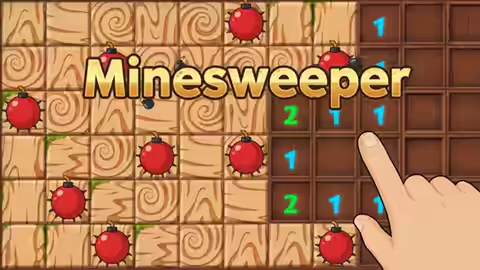
Each number shows how many mines are in the eight tiles touching it, horizontally, vertically and diagonally.
Look over the numbers and work out which tiles are safe and which ones hide mines.
Place a flag on any tile you think contains a mine.
Reveal every tile without a mine to win.
You can choose a difficulty such as Beginner, Intermediate or Expert before you play.
Results After Clearing a Game
Time: Time taken to clear the board (seconds)
3BV: Minimum number of clicks needed to clear the board (its difficulty)
3BV/s: Required clicks per second (speed indicator — higher is better)
Clicks: Actual number of clicks (reveals + flags)
Efficiency: Click efficiency (3BV ÷ total clicks — the closer to 100%, the fewer wasted clicks)
Minesweeper is a classic logic puzzle game where you use the clues hidden in numbers to figure out where the mines are. It's made up of nothing more than a simple grid and some numbers, yet a single choice can decide whether you win or lose, so it calls for sharp focus and logical thinking.
The game begins with a grid of covered tiles. Some of them hide mines, and when you reveal a safe tile, a number shows how many mines are in the adjacent tiles. These numbers are your key clues to where the mines are. By comparing how the numbers relate to each other and combining what you already know, you can work out, one by one, which unopened tiles are safe and which ones hide mines.
The goal is to reveal every safe tile without setting off a single mine. Rather than clicking at random, analyze what the numbers are telling you and base your next move on solid clues. Sometimes you'll need to weigh several possibilities carefully, and every now and then, a little luck comes into play.
Logic puzzles like Minesweeper existed even before personal computers became widespread. Their roots go back to early computer games played on mainframes. 'Cube', developed by Jerimac Ratliff, is known as one of the notable games associated with the early form of Minesweeper.
In the 1980s, a number of software developers and companies released games built on similar ideas, helping the genre grow. Later, when Microsoft included Minesweeper as a built-in game in Windows, it became hugely popular around the world.
Included as a standard game from Windows 3.1 through Windows 7, it became an iconic game that brings back memories of first using a computer for many people. It has since been recreated again and again on all kinds of operating systems and platforms, earning its place as a classic puzzle game.
The greatest appeal of Minesweeper is the deep reasoning packed into its simple rules. Without complex controls or flashy graphics, every single number becomes vital information, and small differences in judgment can change the outcome.
Take on difficulty levels from Beginner to Expert and put your logic and concentration to the test. You can enjoy a quick, casual game or challenge yourself with tougher puzzles to sharpen your skills.
No download or installation needed—play right in your browser. If you want to relive the fun of a familiar classic, give Minesweeper a try now.